2008 KLR 650 (Very) Long-Term Test Report

Sometime in late 2007, I walked into a Kawasaki dealership and bought a 2008 KLR 650 without even throwing a leg over. The choice was based on unrivaled simplicity and a price tag less than that of a Vespa, so what was to test anyway? All it would have to do was to take me to South America.

KLR, The Mature Machine

Truth is, I had tried the 650 KLR before, all the way back in 87 when it replaced the 600. But I was only 16, and similar to the fate of the GS, the thumper had felt sluggish and absolutely gargantuan after my two-stroke RD125LC YPVS. I clearly remember thinking “why would anyone buy this?”. Funny, how we get our answers.

1989 Kawasaki KLR 650 motorcycle
Kawasaki KLR 650 was introduced in 1987 to replace a 600 predecessor.

Yamaha RD125LC motorcycle
This 2-stroke 125cc Yamaha from the same period could run rings around the 650 KLR. It consumed less oil than the revised model too!

As purposeless as it may appear to a speed freak teenager, the KLR 650 has been a major success for Kawasaki, outliving motorcycles like the Tenere, DR Big, and even the Africa Twin. To become a casual addition to its success story, even I would end up owning one 20 years after dismissing it with a shrug. Actually, not just owning, but choosing one over BMW’s legendary flagship, the R1200 GS!

Catching Up

But the 2008 model KLR I was taking back home was slightly different than the one I had ridden, representing Kawasaki’s first revision to the bike since ’87. It was still the same tall, slow, and spiritless thing in essence, but now, it at least wasn’t as much of a relic anymore. Many of the changes were significant improvements, and were key to the bike’s eligibility to join me on the trip down.

The new 2008 KLR 650 sported:

  • Beefier forks
  • Stronger wheels with thicker spokes
  • Better rear shock with a stiffer spring
  • Lower sag on both ends of suspension*
  • More powerful front brake*
  • Powerful headlight*
  • Modern electrical system that can handle auxiliary loads*
  • Standard fuses
  • Fairing for wind protection
  • Bar-end weights for reduced handlebar vibration
  • Slightly more powerful engine

* Key changes without which I would not have considered the KLR

2008 Kawasaki KLR 650 motorcycle
The 2008 model year brought the first revision to the KLR 650 in 21 years.

I had mentioned earlier how the power of the GS had felt like a yawner after riding Hoover (my Speed Triple), so you can imagine my mood on CA 405 after picking up the KLR from the dealership. Perhaps the only thing that felt good about the bike was the tall seating and wide handlebars for a motocrosser stance, almost ready to ride over the traffic. Of course, the side effect of that was being able to touch the ground with the tip of only one foot, but nothing new there.

The good news is, everything is relative, and the KLR’s performance only feels better as you adjust her in time. Fast forward to the curves climbing up to Tuxtla Gutierrez, I was having as much fun as riding the Latigo canyon on the Speed Triple.

Loaded

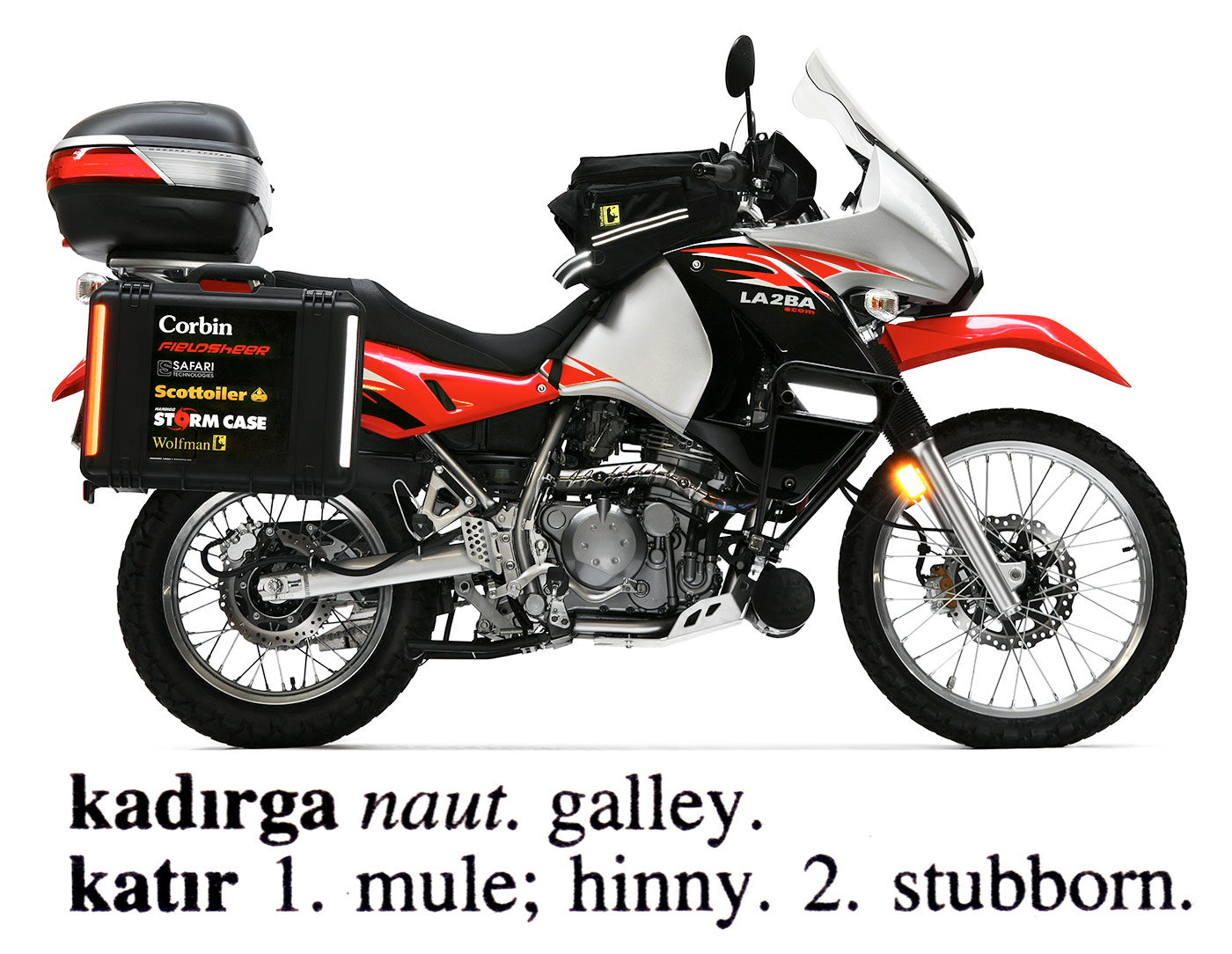
The next couple of months went by preparing Katırga (my KLR) for the long haul, and by the time we left LA, she was almost done with the break in. Once all the cargo and myself was on, the ground clearance was no more than a road bike’s, which also meant I could now touch the ground with both feet! But very few solo travelers will be this heavy on a KLR. (and even fewer will need to be to touch the ground!) Mostly due to all the camera, computer, and rigging equipment on board, Kat was later weighed at 290 kgs. (638 lbs), fueled and loaded.

With all that weight, steering was even slower, but I neither had a problem with stability, nor with the rear bottoming out (much). Most importantly, the oem rear shock commendably withstood everything thrown at it throughout the journey. Nevertheless, upgrading to firmer springs would have made a world of difference in the right direction.

Kawasaki KLR 650 motorcycle loaded
As loaded as a KLR can get. The tight space for the rider means excellent back support.

For a short while during the trip, I also rode two-up with about half the luggage, and that’s where the KLR drew the line, dragging her tail and getting completely out of shape on curves. Unless both riders are light weight and no luggage is involved, I feel that the KLR really shouldn’t be in a shopping list for two-up riding. This holds true even with upgraded suspension, because the extra weight brings the brakes to their limits as well.

Kawasaki KLR 650 motorcycle with passenger
Traveling as a couple? Look elsewhere.

Comfort

As for ride comfort, the combination of a short rider, lowered seat, and the Kawasaki tall screen seemed to be a perfect combination. On cold rides, the KLR’s oversized hand protectors proved priceless.

One thing that might be of concern when considering a single is vibration, and handlebar vibration in particular was a complaint among the users of the earlier model. I never rode with the new bar end weights removed to compare, but I’m guessing they are pretty effective because I didn’t find the vibration objectionable for a single.

Inexpensive or Cheap ?

When you buy a 650cc motorcycle for less than $6K, you naturally adjust your expectations accordingly. So pointing out the glaringly cheap instrumentation would be harsh, had it worked. One of the first things that started giving me trouble was the trip-meter. The pin-like stiff button was hard and suspect from the get go, and resetting the counter had turned into a literally painful ordeal even before covering Mexico. As trivial as it may sound, since I didn’t have a gps until Peru, it was my most valuable tool for determining gas stops. The jiggling and the wiggling worked only for so long and I eventually had to take the whole thing apart in Antigua. What I found inside was appalling, not only in terms of build quality, but also design.

KLR 650 trip meter failure
Wishful design, toy-grade manufacturing.

Unfortunately, the trip meter wasn’t the only thing to give up in Antigua. The “FB” branded oem battery of my 4 month old motorcycle was no longer holding charge. Having it reconditioned got it working again, but in 2 more months it would die completely.

Looking back, now I know that finding the luggage rack bolts (on either side) loose was a clear warning that the two other bolts securing the rack vertically to the tail of the subframe had already snapped. But in Antigua, I just applied some locktite and re-tightened them instead of giving it much thought. It wasn’t until Bocas del Toro that I realized why they kept coming loose despite all that blue Locktite.

The 10 kgs max load rating of the luggage rack is probably quite accurate, and bearing more than twice that weight, it would continue being a nuisance throughout the trip. Replacing the broken bolts in Bocas kept things in place for only a short while before they snapped again, making the upgrade to thicker bolts in Medellin mandatory. But there was yet another weak point: the flimsy metal frame underneath the rack, which eventually buckled and sagged. Finally, before the return trip through Brazil, the frame was reinforced with metal braces, and that was the end of problems with the rack.

KLR 650 rear carrier reinforcement
Don’t leave home before reinforcing the luggage rack.

In conclusion, if you plan to use the rear carrier at all, be sure to make the necessary upgrades. Even if you do not anticipate to exceed its load capacity, keep in mind that some road surfaces can change the game significantly. Not to mention, you never know how plans will change along the way.

One thing that annoyed me about the new KLR was how blatantly superficial some of the “improvements” were. Like breast implants on an 80 year old, the plastic radiator shrouds are sad attempts to camouflage age, slapped on with total disregard to usability. Not only do they get in the way of any work to be done, but do so almost on purpose, as they are held together by a myriad of different kinds and sizes of nuts, bolts, and screws. The theme of hasty design is consistent throughout the body work, almost echoing a suit at Kawasaki saying “just make it look nice by noon and don’t spend a penny!”.

KLR 650 break-down
All the things that need to come off to reach the spark plug make you wish she were an R80.

But getting annoyed from time to time is one thing, having to add oil to a brand new engine at every other fill-up is another. As I discovered in dismay, at a steady 5000rpm with 80mph on the clock (74mph actual), the KLR burns a liter (~1 quart) of oil in just 500 miles. At 4000rpm, the consumption becomes negligible, but so does your speed at around 60mph. And before you suggest a modification to final gearing, let me just remind you that under strong winds even sustaining that moderate 60 can be a challenge in 5th.

KLR 650 oil consumption
The smoking gun.

With unheard of courtesy, the wonderful team at Auteco (Kawasaki Colombia) inspected Kat’s engine, and replaced the piston rings with a new set despite not encountering anything out of spec. Yet, the issue remained the same, confirming that it is an inherent weakness of the new piston/ring design.

KLR 650 oil consumption
1 liter of lubricant per 500 miles has to be a record for a 4-stroke engine.

Before worrying about the oil consumption though, you should first question whether if you’d be affected by it. Many travelers I know ride within 45 – 65mph, even on an empty straight with nothing to look at. This not only saves fuel but also extends chain, sprocket, and tyre life. If this describes your riding style, chances are you’ll be exempt from the trouble. Otherwise, you should be prepared for the 4/2 stroke experience.

No (Electronic) Brain, Still Headache

One of the main reasons for my choosing the KLR was its freedom from electronic gadgetry, since I dread electrical problems more than any other. So when the gauge needles started dancing around on the way back from Patagonia, I knew I’d be dealing with woo-doo. We were able to make it from Mendoza to Rio Cuarto where I somehow “fixed” it. But when you fix things and don’t even know how, they come back to bite you at a worse time.

I didn’t have to wait long. Riding through a town the next day, Kat suddenly died. The net effect was similar to hitting the brakes with no reason, and no brake lights. Once again, I was able to get her going with my magic touch. Days later, it would catch me again, in pouring rain, on a two laner full of trucks.

KLR 650 electrical problems
Electrical problems can be the hardest to diagnose and cure.

Long story short, I was hit by exactly what I was trying to avoid by riding a primitive machine. Had I not heard of the recall by pure luck, I have no idea how much time and money I’d have wasted before eventually replacing the entire wiring harness, which had self-destructed through abrasion. A replacement had to come down from the US and was not covered by the recall as the bike was out of the country. Much later in Brazil, despite the extra care and armoring I used, a similar problem would require a friend from the road to come to my rescue. So much for avoiding electrical woes by choosing a KLR.

A Trooper

Other than a weld on the exhaust due to washboard roads on the way to Machu Picchu, and a cleanup after the bad gas in Suyckutambo, most of the mechanical work required during the trip was simply routine maintenance. The carburetor needed a thorough cleaning after storing the bike for 6 months in Argentina, before the return trip through Brazil. I replaced the clutch set in Salvador at 35.000 miles, which I thought was commendable for a friction-plate type unit, considering all the weight and my immature riding style.

Thus, Kat did complete the 42.000 miles of the expedition with no mechanical breakdowns.

Speaking Too Soon

Hoping to continue traveling later, I stored her once again, in Colombia. When I returned after 8 months, the carb required another cleanup despite having made sure that the float chamber was empty when I left. Then, shortly after leaving Cali, I started having cooling problems at low speed, and had to haul heinie all the way to Medellin. The fan motor was fine, but replacing the fan switch or the radiator cap didn’t fix the issue. So off came the crankcase, and plop, fell the water pump. The tip of the pump shaft was broken, which meant major engine work, and parts having to come down from the US once more.

Traveling again didn’t happen for me, and after getting her ready for a new journey with new rotors, pads, tyres, and you name it, I had to sell Kat and return to US. She took her new owner all the way back down to Ushuaia with no problems, got sold again, and settled in Chilean Patagonia to keep roaming one of the most beautiful parts of the planet.

Why so harsh?

As I go over all the things I’ve written so far, even I can’t believe how hard I have been on the motorcycle that has taken me through an entire continent almost without a hitch, on routes where I’ve come across stranded motorcycles that cost three times as much. But I think I know why…

No matter how advanced or tough, all modern bikes of today are sissies compared to those of the past which required nothing but some gas and a kick to fire up. The KLR was the last standing motorcycle close to the spirit of that heritage. When Kawasaki revised it, I had imagined an already tried and tested motorcycle becoming bullet proof to create a category of its own. Such romantic naiveté!

Motorcycles are designed and built around sales numbers. Kawasaki could have built a rugged legend out of the KLR, but very few would pay the extra dollars it would take. So, they gave us a new KLR with flashy looks, and not much in the way of smart design or quality engineering. As always, we got what we’d pay for, and the product that could have been faded out of becoming.

No Contest

Our love and hate relationship aside, the KLR has taken me on an incredible journey few other bikes can offer comfort on. Although I realize that you might expect me to arrive at a conclusion after dragging you through 2500 words, I’m afraid the whole experience has left me even less sure about the right motorcycle than in the beginning.

But I can at least tell you this much: somehow it all seems to work out anyway, and chances are, what you ride does not make a journey better or worse, just a little different.

As someone I know likes to say: What’s gonna happen, right?


The Ultimate Adventure Motorcycle

Many motorcycle travelers start planning their trips several months ahead. When the preparations begin, the to-do list seems to keep growing rather than shrinking, and time literally flies.

Back in 2007, when the idea of a motorcycle journey came up, the target destination automatically implicated a departure date only 2 months ahead. If I could leave before October, I could hope to make it to Ushuaia before everything froze.

To add to the challange, I neither had any gear, nor the motorcycle. Well, I did have a 1050 SpeedTriple at the time, but since that ride from Istanbul to Juan Les Pins on an FZR, I’d known better than traveling on a sports motorcycle.

On the other hand, not having a travel bike meant I could objectively evaluate my choices and get the one that fit the bill the best.

The Modern “Best”

Heading out into parts of the world where stocking spares for expensive toys is not of top priority, the no brainer is a need for simplicity. For every advantage modern technology provides, there is an associated risk of failure that significantly outweighs it. The argument that modern components are “reliable” is a moot point, because I’d rather have 5 reliable components to ride on than 50.

Sophistication not only introduces more things that can go wrong, but it also makes less things repairable. Specialty tools, proprietary parts, and skilled engineers are pretty much guaranteed to not be there where you’re going. Heck, it can be hard to find them even in L.A.!

I had bought my Speed Triple brand new, and to this date I remember her as the most inspiring, delightful motorcycle I have ever ridden. At the same time, no other bike had given me so many problems within just 4000 miles. One of her random fits in particular, was absolutely irritating. Out of the blue, she would just refuse to fire up. After trying all the woo-doo tricks mentioned in forums, I took her to Triumph. The tech hooked her up to a hand-held diagnostic device, ran some tests, then told me that there was nothing he could do, as all looked normal.

This is the typical “service” experience with modern machinery. Your bike is sick. Perhaps she’s completely mental, since they all have “brains” nowadays. But when you take her to be diagnosed, the procedure is to ask her “what’s wrong”! And if there is no answer, the cure is very unlikely to arrive before you loose it too.

Triumph Speed Triple 1050 motorcycle
The Speed Triple is a fantastic motorcycle, but probably not the best choice for riding to Bolivia.

Now imagine heading out to the unknown on a motorcycle like this! Even if nothing were to go wrong, you’d never have the peace of mind. The one thing you don’t want to be without on a journey could well be held hostage by your state-of-the-art “dream” machine.

But in an age where even keys are electronic, who do you turn to for a basic, reliable, and capable motorcycle?

The Price Of The Beast

Could your concerns be limited to mechanical or electrical troubles, you’d still be having it easy. Many other things can happen to a bike, from turning into a wreck to disappearing into thin air. (Insurance? That word just makes me laugh for some reason.) This is when the sticker price of a motorcycle becomes all important, because the question is not whether if you can afford the one you want, but whether if you can afford two of them! Suddenly, the dollar difference between your two options is doubled, and quite possibly now exceeds your travel budget for a whole year’s trip!

Not to mention, the flashier a motorcycle, the likelier it is to be selected for “picking up”. But there is yet another reason you may not quite want to be associated with a bike worth multiple years’ income for many of the wonderful people you will meet: “separation”. The cost of your motorcycle will be the second or third most asked question, and everytime I answered it, I was glad the number was a modest USD 5.500.

What I found interesting was how price and budget were important independently from each other, and that neither turned out to be the first eliminating factor when evaluating eligible bikes.

Traits Of The Ultimate Adventure Motorcycle

So what technical traits would make a motorcycle ideal for long distance travel that extends beyond the asphalt and city lights?

The unordered list probably everyone would agree with is:

  • High load capacity
  • Room for cargo
  • Long fuel range
  • Low octane fuel compatibility
  • Organic motor oil compatibility
  • Commonly available tyre sizes
  • Rims suitable for tubeless tyres.
  • Spoked wheels for strength and repairability.
  • Good weather protection
  • Comfortable riding position
  • Low weight
  • Easy maintenance
  • Easy access to battery, air filter, spark plug(s)
  • Electrical system that can support auxiliary equipment
  • Capable suspension
  • Powerful, torquey engine
  • Center stand + side stand

My list for LA2BA also included:

  • CV Carburated engine
  • Liquid cooled engine*
  • Minimal electronics (No TCS, ABS, or other BS)
  • Unused
  • A globally popular brand
  • Low enough seat height to tip-toe, preferably with both feet (I’m 5’05″ on a good day)

* Although liquid cooling adds complication and weight, after having fried an air cooled cruiser crossing the Sonoran desert a while back, I’d been considering it a requirement.

Sex And The Sticks

With bikes like the Tenere and DR Big gone the way of dinosaurs, Bayerische Motoren Werke seemed to be the only manufacturer still enthusiastic about dual sport motorcycles, and with the new 1200 GS they had even succeeded to turn the image of the company around, from odd, old, and heavy, to outright sexy.

Suzuki DR BIG dual-sport motorcycle
The mighty Dr Big. Is this where things should have stayed?

Admittedly, being a guy makes it really hard to choose reason over sex, and although I knew the GS twin was loaded with gimmickry to the teeth and cost an arm and a leg, I did go for a test ride in San Francisco. But see, I went there on the 1050 Triumph, a street motorcycle with a ton of torque, ruler-straight power curve, and telepathic steering. Immediately, the build quality of the GS stood out, making my bike look like a Jawa in comparison. After that though, it was all down hill for the BMW. Having to wrestle her into a curve, then trying to get her back up was the weirdest thing. Then, she made me giggle at the red lights, with that twitch at every twist of the throttle, unmistakably ancient boxer despite all the high-tech on board. The transmission was clunky, and the legendary power… A big fat yawn. Impressed with nothing but the power of the servo brakes, I was relieved that she couldn’t tempt me out of my money.

BMW R 1200 GS dual-sport motorcycle
The big Beemer is sexy. But the sexy Beemer is big.

So, the first to go out of the picture was BMW, if only because Ducati and the exotic likes did not even get into that picture. True, there was also the F650, but it was essentially an unnecessarily complicated KLR for twice the money. Plus, who in their right mind would install 2 heavy exhaust canisters on a single-cylinder dual-sport motorcycle and expect to be taken seriously?

The one other option I considered briefly was the V-strom 650, but it offered neither the simplicity, nor any excitement. In the end, I think it boiled down to pure desire vs pure reason, and once the GS failed to impress, it was (all the way) down to the KLR.

Thus, I walked into a Kawasaki dealership and bought an ’08 KLR 650 without even throwing a leg over. On the way back home, all I could think was “Oh boy, I’m going to South America on a very tall scooter with rubber forks”. 

2008 Kawasaki KLR 650 dual-sport motorcycle
In the US, the KLR 650 is the last bike standing with simplicity.

Ultimately however, it wasn’t the performance shortcomings of the KLR that disappointed me. I was expecting the KLR to compensate for those shortcomings by delivering dependability, and there, she let me down.

Square One

Fast forward more than 5 years and 42.000 miles, the dual-sport motorcycle class is booming, with many new objects of desire in the market, all racing each other for further sophistication. And unless you intend to build your own bike or restore a pre-owned motorcycle, you still have a single option for simplicity: the KLR.

As I now ponder hitting the road again, possibly heading to even more remote regions, I find myself where I had started, with the same list in hand. The ultimate adventure motorcycle might be an utopia, but how could I get closer to it this time?

Motomorini Granpasso dual-sport motorcycle
A delicious Motomorini Granpasso, yours for 18 months for USD 8000. But how far would you dare take her?

2013 BMW F800 GS Adventure dual-sport motorcycle
This time around, I may be looking more in this direction with fingers crossed.


Not sure how this is relevant. But what was I talking about anyway?